






What Percentage Of Income Should Go To Mortgage? A Simple Guide
Buying a home is one of the biggest adventures of your life. However, before you even start looking at properties, you might probably have one question in your mind:
What percentage of income should go to mortgage payments?
It is easy to get lost in a sea of numbers and math. Let’s break it down into simple, everyday language so you can figure out what works best for your wallet.
The Magic 28% Rule (And What It Actually Means)
When doing your research, a rule of thumb that comes up quite often as a traditional method of allocating income is known as the 28% Rule.
In simple terms, this method states that your income from your house payment alone should not exceed 28% of your pre-tax income.
Let’s calculate the maths with an example. Suppose your annual income is £40,000.
- A deduction of tax and other payroll-related charges would likely reduce your take-home pay to around £30,000, which works out to approximately £2,500 per month.
- Applying the 28% Rule, you would have to limit your rent and/or mortgage payments to about £700 a month.
Why One Size Does Not Fit All?
There is great diversity among people in this world, so naturally, you can’t expect a single answer to work for everyone.
Indeed, there are those who spend more than 28% or less than 28% of their earnings.
According to Nationwide records, the typical first-time buyer spent 37% of their after-tax income on their mortgage in 2021.
You should factor in your personal situation when calculating the proportion of your earnings that your budget allows for housing.
What questions should you ask yourself when deciding on this matter?
What is the situation with your debts now?
Do you have car loans or student loans?
What style of life do you like? Is there anything that is a must for you? Are you into sports?
You may need to consider how to manage your money if you prefer an active lifestyle to a quiet, relaxed one.
What kind of savings plans do you have? You may feel like having your monthly savings as a sort of safety net against any unforeseen circumstances, which is fine.
How Much Will A Lender Actually Let You Borrow?
Mortgage lenders have also started getting hands-on as they work to understand your personal budget.
A basic rule of thumb is that most lenders allow you to borrow around 4.5 to 5 times your salary, if not your income.
However, a couple of lenders may offer up to 7 times your income in exceptional circumstances.
Hence, if you are earning £40,000 a year, a lender could offer a mortgage of £180,000 to £200,000.
But they do not only base their decision on your salary. Lenders also conduct something they call affordable check.
From your bank statements, they will find out the exact amount of cash you set aside for groceries, bills, and entertainment each month.
They want to be very sure that you have enough money coming in each month to make all your repayments without any trouble.
So, it is crucial to be absolutely confident that the amount you borrow can be comfortably managed as a mortgage for your home in future.
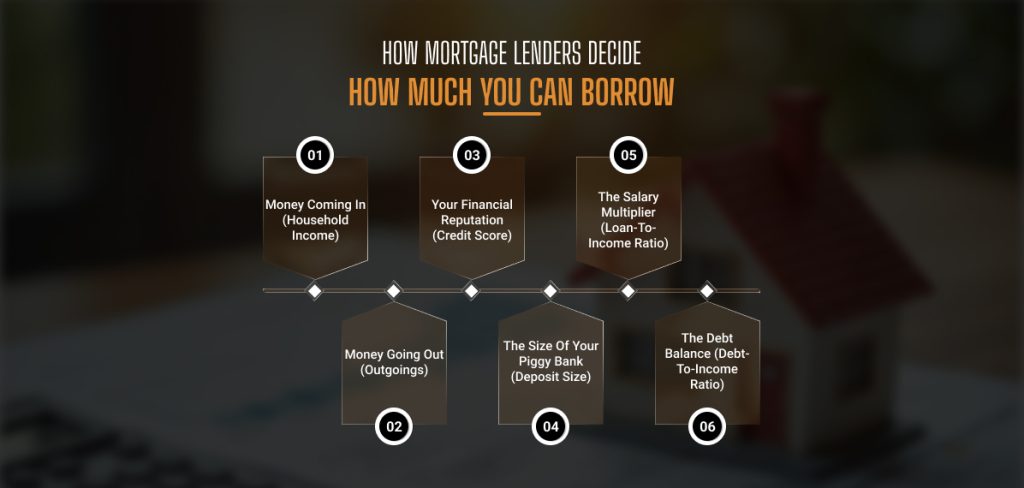
How Mortgage Lenders Decide How Much You Can Borrow
When you are ready to buy a home, figuring out your own budget is just the first step.
The next big question is: how do mortgage lenders actually decide how much cash to hand over to you?
When you apply, a lender will take a closer look at your financial situation. This can help them to determine what you can comfortably repay.
To do this, they check six major things. Let’s walk through them together in plain, simple English!
1. Money Coming In (Household Income)
First things first, lenders need to know about the cash you have coming in.
However, they don’t just look at your basic salary. They also count other types of income, such as:
- Overtime pay and work bonuses
- Money from a second job
- Pension money or cash from investments
- Child maintenance or financial support from an ex-partner
To prove this money is real, you will need to show them your official payslips and bank statements.
Furthermore, if you work for yourself (self-employed), you will usually need to provide two or three years’ worth of tax returns and business accounts to prove your earnings.
2. Money Going Out (Outgoings)
Lenders do not just care about what you earn; they care deeply about what you spend.
Therefore, they will look at your monthly household bills, including council tax, gas, electricity, water, and broadband.
They also check for fixed costs like car lease payments, childcare costs, and school fees.
On top of that, they look at your everyday lifestyle spending. This includes how much you spend on groceries, holidays, and fun weekend activities.
They do this to make sure you have enough breathing room left over for a mortgage payment.
3. Your Financial Reputation (Credit Score)
Lenders will always pull your credit report to see how well you have managed money in the past.
If you have a history of bad credit, it might be tougher to get a loan. Even if you are approved, you might be allowed to borrow less money or be charged higher interest rates.
This is the reason why it is super important to improve your credit score as much as possible before you apply.
4. The Size Of Your Piggy Bank (Deposit Size)
Usually, you need to save at least a 5% deposit to get a mortgage, though some special deals require even less. However, saving a bigger deposit comes with huge perks.
First, a bigger deposit unlocks lower interest rates, which makes your monthly payments cheaper.
Consequently, a lender might decide you can afford a larger loan because your monthly costs will be lower.
Second, some lenders will actually let you borrow a bigger multiple of your salary if you put more money down.
For example, HSBC caps your loan at 4.49 times your salary if your deposit is under 15%.
But if you bring a 15% deposit or more, they might let you borrow up to 5.5 times your income!
5. The Salary Multiplier (Loan-To-Income Ratio)
This is a quick math trick lenders use. They take your income and multiply it to find your maximum loan size.
Most lenders will typically offer you 4.5 to 5 times your salary. So, if you earn £40,000, you can usually borrow up to £200,000.
But every lender has its own rules, and some will go up to 6 times your income depending on your situation.
For instance, Nationwide allows home movers and remortgaging customers to borrow 6 times their salary.
If you are a brand-new customer, you can still get this 6x deal, but you must earn at least £75,000 individually or £100,000 as a couple.
If you are a very high earner, the numbers get even bigger! For example, HSBC offers up to 6.5 times your income with a Premier Account.
To get that account, you need to earn over £100,000 a year or have £100,000 in savings with them.
6. The Debt Balance (Debt-To-Income Ratio)
Finally, lenders look at your Debt-to-Income (DTI) ratio. This compares your total monthly debt payments to your gross monthly salary before taxes.
The debt payments include:
- Credit card payments,
- Loans,
- Your future mortgage
You just divide your monthly debt by your monthly gross income, then multiply by 100, to find this number.
For example, if your total debts cost £1,000 a month and your gross income is £3,000, your ratio is 33.3%.
Here is how lenders look at your score:
- 0% to 39% (Good): This means you are a low or acceptable risk. Lenders love to see this!
- 40% to 49% (Moderate Risk): You might have to jump through a few more hoops and answer extra questions to get approved.
- 50% or Higher (High Risk): The application process will be much tougher, and you will likely be offered higher interest rates because the lender is taking a bigger gamble on you.
Popular Budgeting Rules: The 28/36 And 35/45 Guides
Two classic guidelines often come up when people ask what percentage of their income should go toward mortgage payments.
They are great starting points, but you should treat them as friendly suggestions rather than law.
The 28/36 Rule
This classic rule suggests that you should split your gross monthly income (your pay before taxes) into two clear limits:
- Housing Costs: No more than 28% of your gross income should go towards your monthly mortgage payments.
- Total Debt: No more than 36% of your gross income should go towards all of your debts combined.
This includes your mortgage, student loans, credit cards, and car finances.
The 35/45 Rule
This rule operates in a very similar way but changes the percentages slightly to give you a different perspective on your wallet:
- It suggests keeping your mortgage payment capped at 35% of your gross monthly income.
- Alternatively, it says your mortgage should take up no more than 45% of your net monthly income (your actual take-home pay after taxes).
How To Figure Out What You Can Honestly Afford?

While lenders have their own formulas for determining your maximum loan amount, you need to look inward and figure out your personal comfort zone.
You do not want to end up “house poor”. This means you own a beautiful house but have zero cash left over for dinner with friends or a weekend getaway.
When you sit down to calculate what percentage of income should go to mortgage payments for your lifestyle, make sure to consider these critical questions:
· What Do Your Job Prospects Look Like?
Consider your current salary, job security, and any expected pay rises. If you expect a big promotion, you might feel comfortable borrowing more.
However, always ask yourself: How would I cope if I lost my job, or if we decided to start a family?
· What Are Your Real Living Costs?
Be completely honest about what you spend each month.
Moreover, you must always leave some extra wiggle room in your budget because essential bills like electricity and groceries can suddenly go up in price.
· How Does It Compare To Your Current Rent?
If you are already struggling to pay your rent, and your new mortgage payment will be higher, it is a clear sign that you might be stretching yourself too thin.
· Can You Handle Basic Home Maintenance?
Many first-time buyers are shocked by the costs of owning a home.
When a pipe bursts, the roof leaks, or the boiler breaks, there is no landlord to call. You have to pay for those repairs yourself.
· Do You Have A Financial Safety Net?
Consider how much you have in savings or if you have family support to back you up.
Moreover, if you have a solid safety net, you might feel comfortable pushing your budget a bit higher. If not, it is much wiser to be conservative.
· What Is Your Emotional Relationship With Debt?
Some people sleep perfectly fine with a large mortgage, while others feel incredibly stressed by big debts. Always honour your personal appetite for risk.
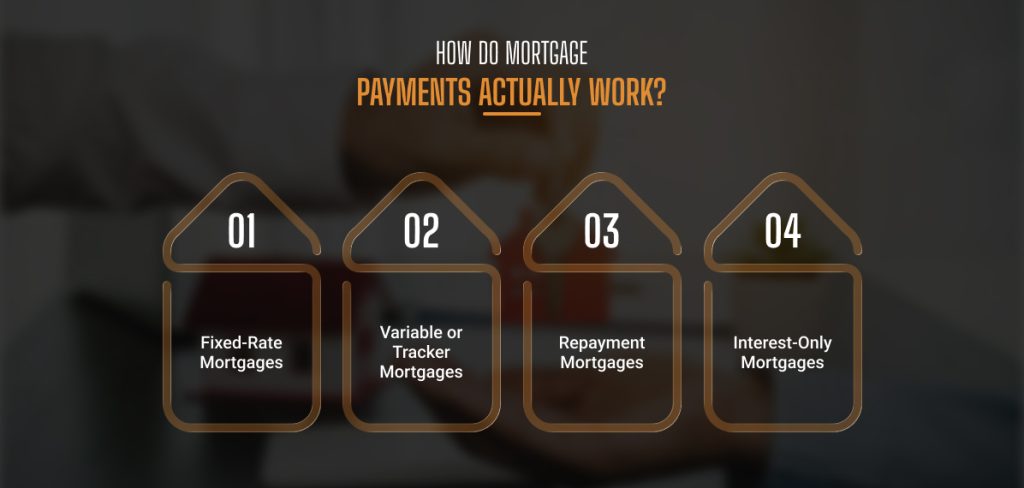
How Do Mortgage Payments Actually Work?
When you sign on the dotted line, you agree to repay the lender each month for a set number of years (the mortgage term).
The way your monthly payments behave depends entirely on the type of mortgage you choose:
· Fixed-Rate Mortgages
Your monthly payments will stay exactly the same for a set period (like two, five, or ten years), no matter what happens to interest rates in the news.
· Variable or Tracker Mortgages
Your monthly payments can go up or down depending on the wider economy.
· Repayment Mortgages
This is the most common option for buying a home. Each monthly payment covers interest and pays back a small portion of the original loan balance.
By the end of your term, your mortgage is completely paid off.
· Interest-Only Mortgages
Your monthly payments only cover interest. You do not repay any of the original loan balance.
So you still owe the full amount at the end of the term. These are rarely used for normal homes and are mostly used by landlords buying rental properties.
Online mortgage calculators are a fantastic place to start.
An affordability calculator can show you what lenders might hand over based on your salary, while a cost calculator will show you exactly what those monthly payments will look like in cold, hard cash.
Don’t Forget the Hidden Costs of Buying a House
When you get a mortgage, you have to budget for a few extra bills that go beyond your monthly loan payment.
Lenders will often look at these when reviewing your application.
Essential Insurances
· Buildings Insurance
Almost all mortgage lenders will insist that you buy this before releasing the money. It protects the house’s physical structure.
This ensures the lender’s investment is safe if the property is damaged by fire or storms.
· Contents Insurance
Lenders will not force you to buy this, but it is highly recommended. It covers your personal belongings against theft, fire, or accidental damage.
· Life Insurance
You do not legally need this to buy a house, but it is an incredibly smart move if you have a partner or children who rely on your income.
Moreover, it ensures the mortgage can be paid off if the worst should happen to you.
Upfront Mortgage Fees
Getting a loan comes with its own setup costs. Here is a handy breakdown of the typical fees you might need to pay to your lender or broker:
| Mortgage Fee Type | What You Can Typically Expect to Pay |
|---|---|
| Arrangement Fee | Up to £1,500 |
| Booking Fee | Up to £250 |
| Mortgage Valuation Fee | Up to £300 |
| Telegraphic Transfer Fee | £25 to £50 |
| Mortgage Account Fee | £100 to £300 |
| Mortgage Broker Fee | Anywhere from £0 to thousands of pounds |
| Early Repayment Charge | 1% to 5% of your loan balance (if you pay it off early) |
| Exit Fee | £75 to £300 |
The True Cost Of Buying A House And Your Step-By-Step Mortgage Journey

Buying a home is incredibly exciting, but the price listed in the property listing is rarely the final amount you need to prepare for.
Beyond your monthly payments, there are several upfront costs and moving expenses that can catch you off guard.
When you sit down to calculate what percentage of your income should go toward mortgage payments, you must look at the whole picture.
Let’s break down the hidden costs of purchasing a property, how to build your deposit, and the exact step-by-step journey to securing your loan.
The Hidden Costs of Buying a House
When saving up, remember that the purchase price is only part of the equation. In fact, additional purchase costs can add up to 7% to the house price.
Here is what you need to budget for:
- Total Purchase Fees: In addition to the property price, you must pay Stamp Duty, conveyancing fees for legal work, surveyor costs, and mortgage setup fees.
- Selling Your Old Place: If you are selling an existing home to move into a new one, do not forget to factor in the estate agent fees.
- Furnishing Your New Space: Buying a house usually means buying new things. On average, home movers spend around £5,000 on new goods and furniture.
- Renovations and Emergencies: Consider what urgent tasks cannot wait. Do you need emergency work like fixing a broken boiler right away, or do you plan to replace the kitchen as soon as you move in?
Figuring Out Your Deposit
To get a mortgage, you will usually need at least a 5% deposit, though it is sometimes possible to find deals with smaller deposits or even no deposit at all.
However, saving a larger deposit is highly beneficial. A bigger down payment gives you a much wider choice of loans and unlocks the very best first-time buyer mortgage rates.
Keeping your deposit high is a great way to manage how much of your income should go toward mortgage expenses each month.
This is because a lower interest rate makes your monthly payments cheaper.
Your ultimate deposit size depends on:
- Your personal savings: If you are actively saving for a home, consider a Lifetime ISA to boost your savings.
- Family help: Gifted deposits or financial support from parents can give your pot a huge boost.
- Property equity: The cash you raise from selling your current home or extending an existing mortgage.
A quick tip: Add all your savings together, then subtract your moving, buying, and renovation costs, along with a comfortable emergency safety net. Whatever cash is left over is the true deposit you can put down on your home!
Your Step-by-Step Guide To Getting A Mortgage
Securing a mortgage does not have to be stressful. The entire process breaks down into three clear, manageable steps:
Step 1: Get A Mortgage In Principle (Timeline: 30 Minutes)
Here, you get a free official document from a lender, which is also an Agreement in Principle (AiP) or Decision in Principle (DiP).
It states how much they would be willing to lend you based on a quick check of your income and outgoings.
You should get this document as early as possible, ideally before you even start looking at properties.
Showing a Mortgage in Principle to estate agents proves that you are a serious, qualified buyer.
For instance, getting a Decision in Principle through experts like the Mortgage Advice Bureau is quick, free, and will not impact your credit score at all.
Step 2: Formally Apply For Your Mortgage (Timeline: 20+ Minutes)
Now that you have found your dream home and the seller has accepted your offer, it is time for the formal application.
This stage is much faster and simpler if you use a mortgage broker. They mostly handle the lifting and paperwork for you!
You will need to gather your financial documents to prove your earnings:
- If you are employed: Your most recent payslips and your P60 form.
- If you work for yourself: Your last two years of SA302 tax calculations and your official tax year overviews.
Please note: Your home may be repossessed if you do not keep up with your mortgage repayments.
Step 3: Receive Your Official Mortgage Offer (Timeline: 2 To 4 Weeks)
Straightforward applications typically take two to four weeks to receive your official mortgage offer.
During this time, the lender might show interest in:
- Reviewing your documents
- Running a deep credit check
- Hiring a surveyor to do a mortgage valuation
This valuation ensures the property is actually worth the price you agreed to pay.
Delays can happen under three specific conditions:
- If the lender is experiencing a busy season,
- If you are self-employed
- Or if you have a lower credit score.
What Happens Next? (Success vs. Rejection)
• If your application is successful
You will sign the contract with your lender.
Your conveyancer (legal specialist) will complete the final legal work. This way, you can exchange contracts, set a moving date, and release the funds to buy the house.
• If your application is rejected
Do not panic! Mortgages are declined for many common reasons, such as a thin employment history, poor credit history, or carrying too much debt.
If this happens, you need to speak to a mortgage broker immediately.
They can:
- Analyse your previous application,
- Identify what went wrong,
- Match you with a lender whose criteria perfectly fit your situation.
Bank vs. Broker: Which Should You Choose?
When you are looking for a loan, you can either walk straight into your local bank or use an independent mortgage broker.
| Shopping Option | Pros | Cons |
|---|---|---|
| Going to Your Bank | Simple if you already have a checking account with them. | They will only show you their own products, meaning you miss out on cheaper deals elsewhere. |
| Using a Mortgage Broker | They scan the entire market to find a wider range of deals, cheaper rates, and better approval odds. They are also great at answering questions from first-time buyers. | Some brokers charge for their advice. While partners like the Mortgage Advice Bureau offer fee-free paths via specific online forms, going direct to a branch might incur a fee of around 0.3% to 1% of the loan amount. |




Leave A Reply