





Your Local Guide: Cost Of Living In San Diego 2026 incl. Housing, Taxes & The “Kid Premium”
Whether you are a solo remote worker just dreaming of the morning surf or a family looking for that perfect Pacific Coast pocket to raise your kids, you already know that San Diego is breathtaking.
But you can also agree that you are not looking for a location to take sunset pictures! You are here to figure out whether you can afford “America’s Finest city” without living on a strict diet of just bread and water.
So, how much house can I afford in San Diego?
San Diego is a lovely city with splendid weather and a vibrant lifestyle. However, it can be pricey to live there.
The year 2026 is expected to see an even bigger gap in living costs between San Diego and the rest of the country due to high housing prices.
The fees are so high that people renting homes or paying mortgages, plus the added cost of utilities, are struggling to manage.
Along with that, there are also the extra costs, like taxes in some of the best neighborhoods San Diego that some people argue are just part of living there.
The “Kid Premium” is what the locals refer to when families have to pay more for schools and children’s activities.
In this guide, we will explore in detail the cost of living in San Diego now and help you decide whether the “sunshine tax” is worth paying.
Is The “Sunshine Tax” Worth It? A Realistic Breakdown

San Diego’s charm comes at a price: the cost of living San Diego in 2026 is 44 to 46 per cent higher than the national average, with housing the biggest factor, up 112 per cent.
According to recent statistics,
- Residents will have to pay 48 to 50 per cent more for power.
- Food will cost 11 per cent more.
- Transportation will cost 41 to 42 per cent more
San Diego and the Nation: A Quick Comparison
Housing is the main factor: median house price $930K-$1.1M, compared to $440K for the U.S. Average rents are $3,139 vs. $1,598.
SDG&E electricity bills are $398/month compared to $217, while the price of gas is $4.60/gallon vs. $3.15.
The “Comfortable” Number: What Salary You Actually Need
Forget about the generic ranges – $85K-$100 is only enough to live with roommates in Pacific Beach; $130K-$160 can rent a good-sized apartment in Little Italy.
Buying a small house in Tierrasanta requires $225K-$275K. Coastal luxury like La Jolla requires a household income of $400K+.
Renting vs. Buying in 2025: Market is Here
Rent prices of $3K+ for 2-beds hold up, but home prices grow by only 3 per cent to a $990K median, making it better for buyers with 20% down at current rates.
Static inventory makes competition between markets, but barriers to entry remain high.
San Diego Housing Costs: The Biggest Piece Of The Pie
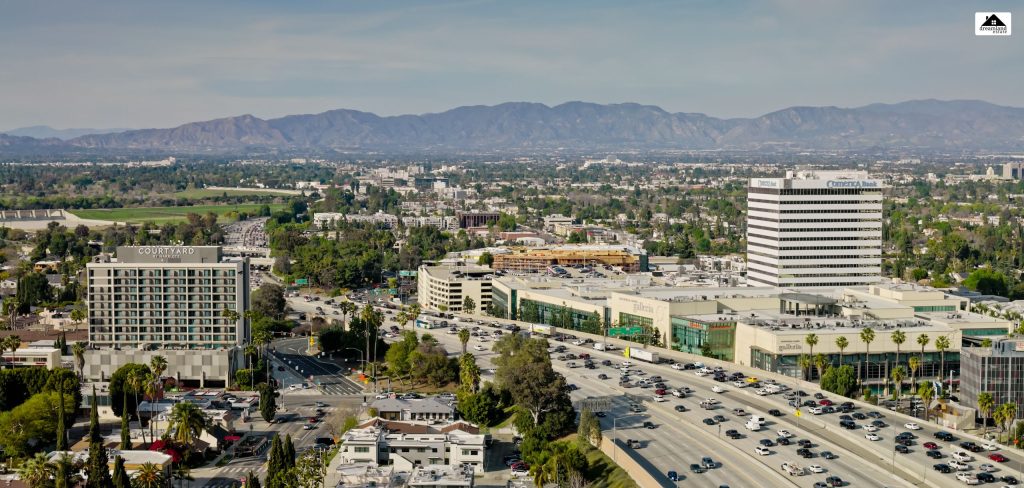
The housing market in San Diego in 2026 clearly show the price gap between coastal and inland areas.
The coastal areas, such as La Jolla and Del Mar, sell houses, and buyers pay almost $1.1 million, reflecting their need and the ocean views they have.
On the other hand, the inland suburbs, namely Escondido and Oceanside, are selling houses at much lower prices, ranging from $700,000 to $780,000, compared to the coastal ones.
In the case of inland properties, better value is provided; nevertheless, buyers have to accept lower prices in exchange for the coastal amenities.
It is impacting their lifestyle and also the utility bills, for example, the cost of air conditioning.
Hidden Housing Costs: HOAs and Mello-Roos San Diego Explained
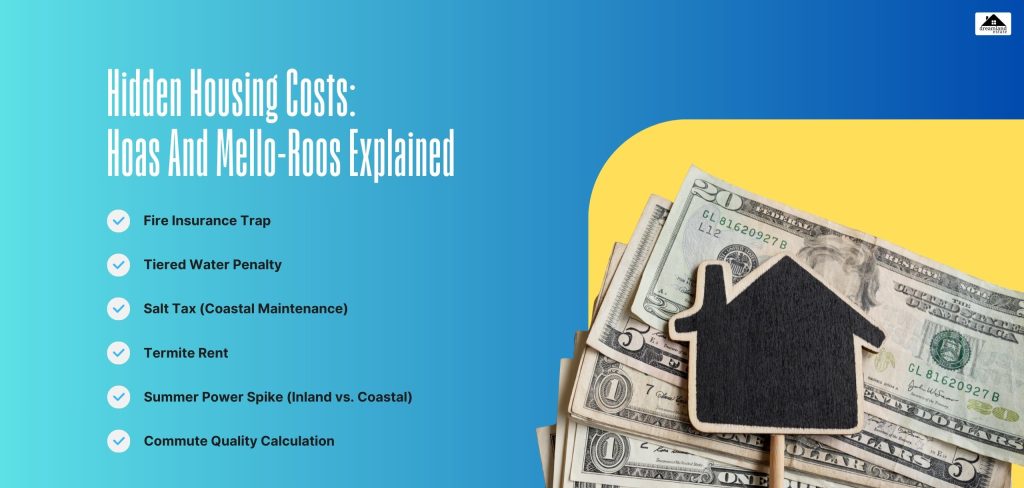
The majority of the newer San Diego communities are experiencing additional costs beyond the mortgage and property taxes. These communities include family-oriented suburbs of 4S Ranch, Del Sur, and Otay Ranch.
The homeowners’ associations (HOAs) charge monthly fees. This is usually $200 or more, to cover community maintenance.
Mello-Roos is a unique tax applied in these neighborhoods to provide necessary services, such as education, infrastructure, and parks.
This tax can increase to $800+ from $200 a month, making it a considerable part of the monthly housing cost.
What is Mello-Roos, and Which Neighborhoods Have It?
Mello-Roos is an additional tax paid by homeowners in newly built areas to fund infrastructure construction.
It can be found in
- 4S Ranch,
- Del Sur,
- Otay Ranch,
- Parts of Carlsbad.
Homebuyers should always confirm whether their property is in a Mello-Roos zone.
In most cases, the unexpectedly high monthly bills catch the new residents off guard.
Utilities Cost & Infrastructure: The “Sdg&E Shock”

The residents of San Diego are experiencing significant financial pressure from high utility expenses, a situation sometimes referred to as “the SDG&E Shock.”
The two main reasons for this pressure are the very high electricity rates and the high water bills.
San Diego Gas & Electric, commonly known as SDG&E, is always among the top utilities in terms of cost, with the highest electricity prices in the USA. The reasons for this are:
- Infrastructure Improvements: Large sums of money are spent on upgrading the grid and implementing fire-prevention measures in high-risk areas.
- Regulatory Costs: The money spent on meeting California’s very high renewable energy goal is included in the rates.
- High Living Expenses: The general cost of doing business in an expensive area is reflected in the utility expense.
At the same time, water bills are a high yet unrecognized cost for property owners, particularly those with beautiful gardens.
These are one of the factors that contribute to the high cost of living San Diego. Among other things, high water costs can be attributed to:
- Imported Water Dependence: San Diego relies on imported water, and it is very costly.
- Infrastructure Repairs and Upgrades: Continuous expenses for treatment and delivery systems improvements.
These high living costs, together, are forcing the population to adopt more energy-conservation habits and switch to drought-resistant plants for landscaping.
The “Kid Premium”: Raising A Family In San Diego

Living in San Diego with a family definitely puts a strain on one’s budget; in other words, it is a cost known as the “Kid Premium.”
This cost comprises all the good things and even beyond them, like education and, more to the point, extracurricular activities. This may cost thousands or even tens of thousands of dollars a year.
If you are a family with kids, it might be a little hard for you to keep your head above water! Every other soccer season, or the dance recital, might feel like just another mortgage payment.
Education Costs: Public Districts vs. Private Tuition
There are excellent public school districts available, but many families are still looking for private options, even though they are very costly.
For instance, tuition at the Francis Parker School for high school grades can reach about $46,500 per year, while The Bishop’s School charges about $49,600 per year.
No doubt, these amounts are a huge investment as compared with public education costs.
So, whether you are juggling the club sports fees in Carmel Valley or the tuition in Chula Vista, always remember that you are not alone in this! We are all trying our ways to create a bridge between the gap, providing an incredible childhood while maintaining a sustainable future.
The Cost of “San Diego Childhood”: Sports & Activities
Moreover, the lifestyle that is typical of Southern California also comes with a price tag.
However, if you want your child to be involved in popular youth activities, it is not only their participation that you have to consider, but also the fees that come along with it:
Junior Lifeguards: The City of San Diego charges about $890 per participant for a single four-week session.
Club Soccer: Prices for competitive (select) youth soccer vary widely. Parents should expect to pay anywhere from $2,500 to $6,000+ per child for the whole year.
$2,500 can be the lowest, and $6,000+ can be the club’s most expensive, depending on the club and the age level.
Surf Camps: Prices vary, but week-long camps are another costly expense in the city, where ocean activities are part of the culture and seasonal as well.
These are just a few examples of the costs. In addition to the high Cost of living San Diego, they all together make up the “Kid Premium,” which is a very important factor to consider for families in San Diego.
Daily Expenses: Food, Fuel, And Fun

San Diego’s daily expenses, comprising commuting, groceries, and entertainment, play a big role in the city’s high cost.
The residents in late 2025 and early 2026 have to deal with expensive gas and parking! Shereas they can cut down on grocery bills by choosing to shop.
It can be either the usually cheaper supermarkets or the more expensive farmers’ markets.
However, it still takes a lot of time for them to find the right compromise between the two places.
Gas Prices And Commuting
Fuel prices in San Diego are consistently high, and the situation in December 2025 was no different, with prices almost reaching $5 a gallon.
The residents of San Diego are forced to pay a lot for their daily trips due to high prices, and commuting is one of the main reasons they rely on cars. The major commuting factors include:
In a February 2025 survey, San Diego was ranked the second most expensive city for commuters in the United States.
The annual commuting cost was estimated at approximately $5,081. Parking in the city center has also seen a price rise, and in 2025, the standard meter rate increased to $2.50 an hour.
Grocery Bills: Farmers Markets Vs. Supermarkets
Consumers in San Diego have a choice between different price ranges for their food.
A person living alone in San Diego might spend anywhere between $300 and $500 a month on groceries. Choices for shopping consist of:
Supermarkets: They set a price throughout the market that is very reasonable, and in many cases, non-organic prices are even lower.
Farmers’ Markets: The price of organic fruits and vegetables might be lower but mixed-up baskets might cost even more than the supermarket equivalent.
Fun: Entertainment And Nightlife
Socializing and leisure activities also add up to the daily expenses. One night out in the Gaslamp Quarter would cost around $60 to $100 per person.
Thus, it is very easy to get through the night without noticing how much money is gone.
The amount you are willing to spend on entertainment will certainly need to be considered alongside the already high necessities such as housing, utilities, and transportation.
The “Comfortable” Number: What Salary You Actually Need

The income categories can determine San Diego’s lifestyle in 2026. It encompasses everything from sharing a Pacific Beach house with a few others to owning a magnificent coastal estate.
The “Surviving” Bracket ($85k – $100k)
You are likely staying in a studio apartment downtown because of your rent or sharing a house with roommates in Pacific Beach.
The beach is near you and aligns with your lifestyle, but owning a property is still in the distant future for you.
The “Thriving Renter” Bracket ($130k – $160k)
As a part of the Cost of living San Diego, living in a luxury one-bedroom apartment in either Little Italy or UTC is one option, or a good two-bedroom rental with this paycheck.
You can afford to go for the more luxurious options in dining and traveling with this salary.
The “Starter Home” Bracket ($225k – $275k)
This income level is the lowest required to buy a basic single-family house or a nice townhome in family-oriented suburbs like Tierrasanta or Clairemont! That too, without experiencing “house poverty” at the same time.
The “Coastal/Luxury” Bracket ($400k+)
The very affluent areas situated to the west of I-5, such as La Jolla and Del Mar, or the larger estates located in the likes of 4S Ranch.
These are now accessible to those in this category, including even private school tuition in San Diego.
Here are the top five private schools in San Diego, along with their estimated annual tuition for the 2025-2026 school year!
| School Name | Location | Grades | Est. Annual Tuition (2025-26) |
|---|---|---|---|
| The Bishop’s School | La Jolla | 6–12 | ~$49,600 |
| Francis Parker School | San Diego | PK–12 | $29,000–$46,500 |
| La Jolla Country Day School | La Jolla | Age 3–12 | $17,050–$38,240 |
| Pacific Ridge School | Carlsbad | 6–12 | ~$35,100 |
| The Cambridge School | San Diego | PK–12 | ~$29,650 |
Detailed Expense Break-Up (Amenities & Hidden Costs)
The Cost of living San Diego is significantly higher than the national average. The overall housing expenses primarily drive this.
| Expense Category | Monthly Cost (Est.) | The “San Diego” Context |
|---|---|---|
| Housing (Mortgage) | $5,500 – $9,000+ | Based on a $1M median home with 20% down at current rates. |
| Utilities (SDG&E) | $250 – $600+ | Warning: Rates can hit $0.68/kWh in peak summer hours. Coastal homes pay less (ocean breeze); Inland homes pay more (AC is mandatory). |
| Water/Sewer | $80 – $150 | Water is “liquid gold” here. Expect higher bills if you have a lawn or pool. |
| Gasoline | $250+ | SD often has the highest gas prices in the USA due to special fuel blends. |
| Junior Lifeguards | ~$450 / session | A “rite of passage” summer camp for SD kids. Essential budgeting for beach families. |




Leave A Reply