





The ‘Fresno Factor’: How to Calculate True ROI on Rental Properties in 2026
When I started using online calculators calculate ROI rental property in the Central Valley, I was astonished to see a phenomenal 12% return on my investment.
It was based on the national average for property expenses. However, I soon realised the Fresno guess was more likely to be wrong.
The current blog will explain why generalised calculators failed to calculate the Central Valley and why using local data is essential for calculating ROI for rental property.
There’s a “Fresno Factor” they overlook: high summer energy bills, mandatory city inspections (RHIA), and extreme heat, which leads to faster breakdowns of HVAC systems.
To arrive at an honest return, one must rely on local data rather than national averages.
Moreover, the average household in Fresno has to spend more than $3,100 a year on electricity.
You may even have to pay a $100 inspection fee for each unit and replace its HVAC units. This cost $ 10k+, earlier than anticipated.
These unavoidable local expenses will determine your real ROI. When we include these local realities, we move from underground guessing to calculating the investment potential.
Generic property investment calculators tease with high returns. Howvever the local data is the only way to avoid unpleasant surprises and to get the right financial picture.
Step 1: Calculate “True” Revenue (Gross Income Vs. Effective Income)
Determining rental income for a property in Fresno is easy to mistake for being rented all the time, as I did.
In the end, you get “Gross Income,” but the truth is more complicated. What you have to decide is “True” or “Effective Income.”
The first step in the process is to find out the actual market rent. Currently, the median rent for a three-bedroom house in Fresno is approximately $1,800.
Here’s a tip: Do not rely on wide averages. Tools such as Zillow Rental Manager or Rentometer for your specific zip code will give much better results.
Moreover, rents can change tremendously just a little north or south of Shaw Avenue. Then comes the budgeting for the vacancy.
So, don’t go for 0%. It is always advisable to set aside 5-6% (about 18 days a year) for a tenant changeover.
There is a subtlety here: The vacancy rate in affordable housing can be as low as 3%, while in luxury houses in North Fresno, it is easy to wait for the right tenant, and hence, the place can remain vacant longer.
Considering this downtime realistically, it is necessary for honest budgeting.
Step 2: The Expense Breakdown (Where Investors Lose Money)

Investors usually lose their money here: they apply national expense averages that completely disregard local Fresno costs.
You should calculate every local fee. To begin with, taxes should be the first item in your budget.
The base rate is about 1.1% to 1.2% of the purchase price. The concealed expense is the cost of the inquiry regarding Mello-Roos or specially assessed new developments (especially in Clovis).
This costs hundreds of dollars a year to add. After these, it shall be the turn of the RHIA (Rental Housing Improvement Act) compliance that must be accounted for.
The city charges an inspection fee of at least $100 per unit for the city’s baseline.
Most importantly, always inquire whether a property has already been placed on the “Code Enforcement Registry” before purchasing it. At last, insurance premiums are rising.
The market is getting tougher because of California’s wildfire risk. Share $1,500 – $1,800 per year for landlord policies.
These are much above the amounts estimated by national averages. If you do not follow these steps, your ROI drops quickly.
Step 3: The “Fresno Heat Tax” (Utilities & Maintenance)
The last stage in a realistic “Fresno property investment calculator” to calculate ROI for a rental property is confronting the heat.
In fact, these are the expenses that the generic tools never mention. Moreover, the “Fresno Heat Tax” should be taken into account.
At first, the summer utility spikes are not just a rumour but a reality. Now, you have to pay for utilities (which is common in multifamily or MTRs).
Then PG&E’s Time-of-Use (TOU) rates are very high during the 4 PM – 9 PM peak, so the costs will be quite high.
Therefore, you need to set aside at least $400 more per month just for the period from June to the end of September.
Extreme heat is the second factor contributing to the rapid depreciation of CapEx (Capital Expenditures).
The national average lifespan for an HVAC unit is 20 years. Due to constant use, one should expect the HVAC to last only 12-15 years in Fresno. As a result, systems need to be replaced sooner than anticipated.
My suggestion to you is to raise your “Maintenance Reserve” budget from the standard 5% of your gross income to 8-10%.
Moreover, the increased reserve will cover the accelerated wear and tear on important items such as A/C units and roofs. This can help you to protect your investment from the scorching heat of summer.
Table: The Generic vs. Fresno Realist ROI
Here is the table that can help understand the differences between the generic ROI and Fresno ROI to calculate ROI rental property!
| Line Item | Generic Calculator (What You Hope For) | Fresno Realist (What You Actually Pay) | The “Why” (Fresno Factor) |
|---|---|---|---|
| Gross Annual Income | $27,600 | $27,600 | $2,300/mo rent. |
| Vacancy Rate | – $828 (3%) | – $1,656 (6%) | Generic calculators assume near-zero vacancy. In Fresno, it takes ~2-3 weeks to turn a unit. |
| Effective Gross Income | $26,772 | $25,944 | |
| Operating Expenses | |||
| Property Taxes (1.2%) | $5,100 | $5,100 | Fixed cost. |
| Insurance | $900 | $1,650 | Fire Risk: Central Valley insurance premiums are ~40% higher than national averages. |
| Repairs & Maint. | $1,380 (5%) | $2,760 (10%) | Heat Tax: Generic uses 5%. Fresno requires 10% due to rapid HVAC and roof wear from UV. |
| CapEx / Reserves | $1,380 (5%) | $2,208 (8%) | You will replace the AC every 12-14 years here, not 20. |
| Property Management | $2,208 (8%) | $2,760 (10%) | Most quality Fresno PMs charge 10% for single-family homes. |
| Compliance Fees | $0 | $100 | RHIA Fee: Mandatory City of Fresno inspection fee (often missed in generic calcs). |
| Summer Utility Surge | $0 | $1,200 | The Silent Killer: Even if tenants pay utilities, you cover vacancy days. If vacant in July, you pay the $400 AC bill. |
| Total Expenses | $10,968 | $15,778 | 43% Higher Expenses! |
| Net Operating Income | $15,804 | $10,166 | |
| Debt Service (Mortgage) | – $19,344 | – $19,344 | Principal + Interest (30yr fixed). |
| Annual Cash Flow | – $3,540 | – $9,178 | |
| Cash-on-Cash Return | -3.3% | -8.6% | Reality Check: This deal does not work as a standard rental at today’s rates. |
So What’s The Insight?
As you can see, if you are planning to buy a 3-bed rental in 93720 with a 25% down, it does not provide any cash flow at today’s rate! So, how exactly are investors making money?
Well, the experts say there are two ways to do so,
- Mid-term rentals: The idea of renting top nurses for $ 3,200/month seems great! This way, you bypass the vacancy while boosting your income.
- Solar value add: Buying homes with paid-off solar can help you eliminate the Summer utility surge risk!
Step 4: Running The Numbers (Example Calculation)
The generic calculator to calculate ROI rental property is showing you a high 8% cap rate. Why? Well, because it does not account for important local expenses.
If you take into account the RHIA fees, higher AC bills, and proper maintenance reserve, your real cap rate is approximately 5.5%
| Metric | Generic Calculator (National Averages) | Fresno Realist (Local Data) |
|---|---|---|
| Expected Cap Rate | 8% | 5.5% |
| Missed Fees | Misses RHIA & special assessments | Includes all fees |
| Maintenance Budget | Underestimates HVAC/Roof costs | Uses a realistic 8-10% reserve |
Thus, it is essential to do your Cash-on-Cash return calculation.
The formula is: (Annual Net Cash Flow / Total Cash Invested) x 100.
For investors using leverage (a mortgage), the cash-on-cash return is more important than the cap rate because it indicates the performance of the actual cash you put in.
By applying the realistic 5.5% cap rate expenses, you not only avoid unpleasant surprises but also receive a true representation of your investment’s performance.
Step 5: Improving Your ROI In Fresno

Once you have realistic numbers for your property in Fresno, the next step is to ask: in what ways can you improve that 5.5% ROI?
You are not limited to a single figure. A good way to enhance your return is to use the two smart strategies discussed below.
First off, think about the “Solar Value-Add” play. The “Heat Tax” from PG&E bills is among the largest expenses.
By going solar, you can offset those summer costs. Moreover, the renters will be willing to pay more for a utility bill that is lower than the area average. It is a win for both parties.
Second, switch to MTRs. Rather than a conventional 12-month lease, you can cater to the needs of travelling nurses who work near hospitals such as CRMC or Kaiser Permanente.
This way, your rental unit will always be occupied, and you can charge a higher price for a furnished rental.
Thus, increasing your annual cash flow considerably. With these strategies, you are in the driver’s seat when it comes to your investment’s performance.
3 Niche Strategies That Outperform Standard Rentals
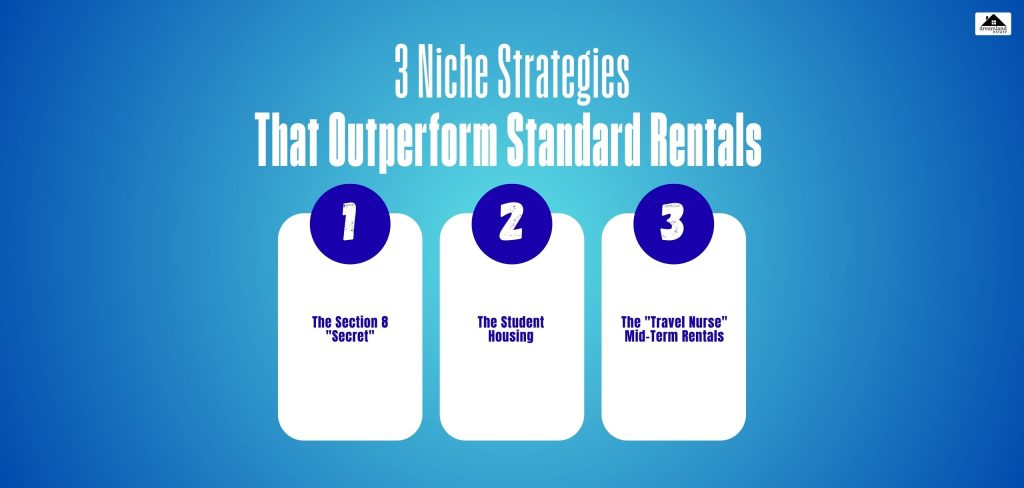
The year 2026 will see the investors are looking for best places to invest Fresno. They are taking advantage of three smart niche strategies. This will economically and effectively target the specific needs of tenants and meet local regulations.
1. The Section 8 “Secret” (SAFMRs)
The Strategy: The Fresno Housing Authority has opted to use the Small Area Fair Market Rents (SAFMRs).
Under this government-backed system, payments for the above-mentioned neighbourhoods are at a higher rate than the city-wide rate.
The Benefit: Subsidies in areas like the 93720 and 93711 zip codes. This is exceeding $2,800 for larger units.
These are the result of the Fresno Housing Authority’s 2025 Payment Standards, which are based on the aforementioned flat-rate standards of past years.
Pros: Payments are made directly to landlords by the government, properties have high demand with no vacancies, and tenants stay for long periods.
2. The Student Housing (The “Per Room” Model)
The Strategy: Go after the 25,000+ students at Fresno State or Fresno City College, using individual bedroom rentals instead of whole units.
The Benefit: A 4-bedroom home in the Bullard/Cedar area (Zip: 93710) that might rent for $2,400 as a family house can make $3,200 total if rented at $800 per room.
Requirements: The landlords will have to cater to students by installing individual door locks for each bedroom and providing high-speed fibre internet as standard.
3. The “Travel Nurse” Mid-Term Rentals (MTR)
The Strategy: Medical professionals working for Community Regional Medical Centre or St. Agnes who are looking for 3-month leases are your “clients”.
The Benefit: Modern and fully equipped two-bedroom condos at Herndon Ave could be advertised on Furnished Finder for top dollar, which is approximately $3,200/month.
Tax Advantage: The 12% Transient Occupancy Tax (TOT) exemption for stays of 30 days or more in Fresno means the landlord can keep a larger share of the rental income than in short-term vacation rentals.
California Landlord Law Updates (2025 Edition)

In 2025, it will be very important for California investors to keep compliant with the law.
The recent laws have passed heavily in the landlords’ favour. As a result, landlords will have to be very careful about tenant verification and keep their administration transparent.
Security Deposit Cap
The New Rule: Landlords will no longer be able to set two or three times the rent as a security deposit, starting in July 2024 and continuing through 2025.
Under California AB 12, the maximum security deposit has its limitation to one month’s rent for furnished or unfurnished units.
The Impact: Owners of rental properties will have to conduct tighter background and credit checks. This can help mitigate the risk of damage, since the financial safety net will be smaller.
“No-Fault” Eviction Tightening
The New Rule: Extensions to the California Tenant Protection Act mean stricter compliance for “no-fault” evictions—say, moving into the unit yourself or doing major renovations.
The Requirement: You must pay the tenant a relocation fee equal to one month’s rent.
And if you are doing the eviction for renovations, you have to attach signed permits and a thorough description of the work to show that the vacating is needed.
The “Junk Fee” Ban
The New Rule: The new transparency laws will not allow landlords to impose “junk fees” hidden in the charge.
The Requirement: Any fees for application or online payment may not exceed the actual costs incurred by the landlord.
The detailed guidelines specifying fee limits are available at the California Department of Real Estate website, where you can also find the information to make your lease agreements legal.





Leave A Reply