






Can You Put A Downrod On A Flush Mount Ceiling Fan? The Dangerous Mistake Most DIYers Make!

When it comes to cooling your home, ceiling fans do a really great job. With it, you do not have to rely heavily on air conditioning and also do not need to pay hefty electricity bills. The best part is that ceiling fans circulate cool air throughout the entire room during those hot days.
You are searching for the answer to “can you put a downrod on flush mount ceiling fan?” and that is why you have landed on this article.
Here, in this article, I will give you the answer you are looking for. Before that, it would be best if you knew exactly what a flush-mount ceiling fan is. So, let’s find that out now.
Flush Mount Ceiling Fan: The Definition

These particular ceiling fans are also named HUGGER FANs. They are basically low-profile fans that are mounted directly to the ceiling. Here, no chain, downrod or pole, or any extra attachment is used for suspending the fan.
In these types of ceiling fans, the motor housing or the fan or the circular unit above the fan’s blades is simply mounted flush to the ceiling and not handled from any type of rod. That means, typically, the blades are suspended from around 5 inches to 10 inches from the ceiling.
For safety measures and better performance, you should maintain a distance of 7 feet high from the floor to the bottom of the fan’s blades.
This 7-foot clearance is not just a suggestion; it is a strict requirement under National Electrical Code (NEC) Article 422. Any room with a ceiling height below 7 feet 5 inches fails this safety code.
Most of the standard mount fan companies position their blades around a foot below the ceiling.
So, you see, these fans will work great in rooms that have at least 8 feet in height. Here you also should note that the minimum gap between the ceiling and the fan’s blades has to be at least 5 inches.
That means you also can install these fans in those rooms with a height of 7 feet 5 inches at least. And in case you have a room that is less than 7 feet 5 inches are considered unsafe.
According to the National Electrical Code (NEC) Article 422, ceiling fans must be anchored to an outlet box listed specifically for fan support.
Adding a downrod shifts the dynamic centre of gravity, meaning you must rate your electrical junction box strictly rated for “Fan Support up to 35 lbs” to prevent structural collapse.
Can You Put A Downrod On Flush Mount Ceiling Fan?
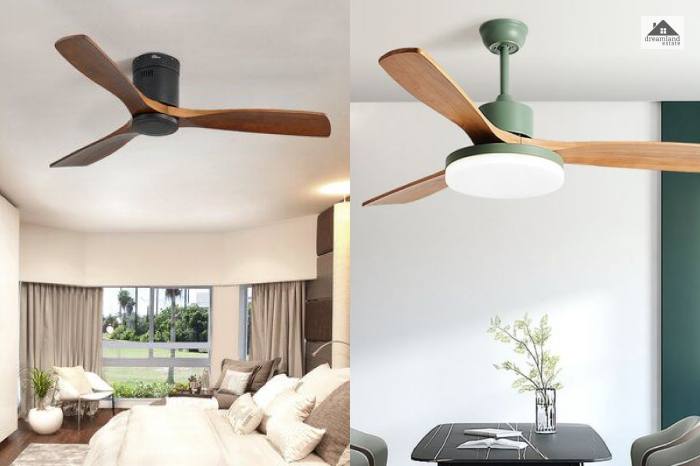
So, now you know what a flush-mount ceiling fan is. That means now I can provide you with the answer to the question you are looking for, “can you put a downrod on flush mount ceiling fan?”
Let’s find out the answer now.
The way a fan is mounted always affects its performance along with its appearance. Yes, flush-mount ceiling fans have their own merits. However, the downrods are mostly preferred to install a ceiling fan due to their improved air circulation and versatile applications.
But when it comes to “can you put a downrod on flush mount ceiling fan?”, there are several factors that play a major role. This article will give you all the necessary information that you need to know.
You just need a conversion kit for converting a flush-mount ceiling fan into a downrod ceiling fan or installing a flush-mount ceiling fan with a downrod. As you might not know that some fans come with dual-installation features, and in that case, you will not need any conversion kit.
You just need enough long wiring to change the installation and enough height in the room. As I have mentioned earlier, for setting up this type of ceiling fan, the height of your room has to be a minimum of 7 feet 5 inches.
But when you are thinking about setting up this specific ceiling fan with a downrod the height of your room has to be more.
The Science of Airflow (The “Why”)
In HVAC terms, flush-mount fans suffer from a ‘starvation effect.’ Because the blades sit too close to the ceiling, they cannot draw enough air from above.
Adding a downrod creates an air reservoir, increasing the fan’s CFM (Cubic Feet per Minute) airflow efficiency by up to 25% without increasing your power bill
How A Downrod Impacts Seasonal Efficiency?
Converting your flush mount fan to a downrod system completely alters how your room manages temperature year-round:
- Summer Mode (Counter-Clockwise)
With a downrod, the blades can properly pull trapped air from the ceiling reservoir.
This further pushes a high-velocity downward breeze directly beneath the fan, multiplying the wind-chill effect.
- Winter Mode (Clockwise)
Flush mount fans struggle to displace rising warm air in the winter because the blades are too close to the ceiling.
A downrod positions the blades perfectly to draw cool air up, forcing warm air trapped at the ceiling down the walls without causing a chilly draft.
The 40% Airflow Stat
The Airflow Penalty of Hugger Fans: Industry tests show that a true flush-mount fan moves up to 40% less air than a fan installed with a short downrod.
They choke off the air supply because the blades sit too close to the ceiling.
The conversion to a downrod eliminates this restriction. Moreover, this vastly increases your fan’s CFM (Cubic Feet per Minute) output without using more power.
Converting For Sloped Or Vaulted Ceilings
A major reason homeowners attempt a downrod conversion is dealing with a sloped ceiling.
Flush-mount fans cannot be installed on angled ceilings because the blades will physically strike the slope.
A downrod conversion kit utilises a specialised ball-joint hanger bracket.
This allows the downrod to hang perfectly straight up to a 38-degree angle, giving the blades the necessary clearance to spin safely.
How To Set Up A Flush Mount Ceiling Fan With A Downrod?
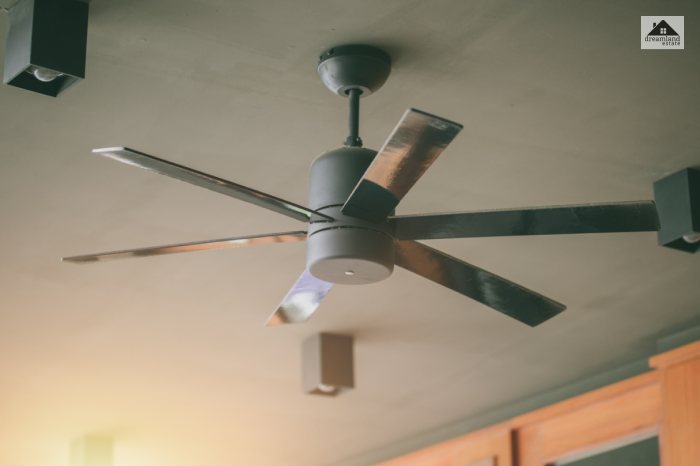
As I have told you, the answer to your question, “can you put a downrod on flush mount ceiling fan?” is yes, as long as you are making a proper conversion.
Yes, you can actually convert this particular ceiling fan into a downrod fan. However, you have to remember that all fans are not at all designed for this particular adaptation. Along with this, there are more factors, such as the height of the cleaning and also the wiring.
These will determine whether this kind of ceiling fan can be installed with a downrod.
Attach The Downrod

You need a mounting bracket to connect the downrod to the fan body.
It will be secured to the junction box. You need to check whether your flush-mount ceiling fan has a hole at the top of the motor.
You must secure the downrod to the motor housing using a factory-approved clevis pin and cotter pin, then tighten the motor’s built-in set screws to eliminate rotational wobble.
That is the point where you can connect the downrod. In case you can not find any.
Then that particular piece is not for installation with a downrod. To match the downrod design, the slot can be threaded or left unthreaded.
And, in case you think that you can make a hole by yourself on an already purchased flush ceiling fan, I will ask you to drop that idea right here, right now.
Attempting these types of tasks can damage the motor.
You might end up with a damaged fan that does not work or becomes too dangerous to use.
Keep in mind that the design of the flow ensures the downrod fits snugly into the fan’s motor.
It will always ensure the entire setup is stable and capable of supporting the fan’s weight, even when the fan is running at full speed.
Now, you have fitted one side of the rod with the fan’s body. What about the other part?
Well, you need to connect the other end of the rod to a mounting ball pre-installed in the mounting bracket.
If the installation bracket you have cannot accommodate the mounting ball, I will ask you to get one with a slot to insert the ball.
Sufficient Long Wires

When you are installing a ceiling fan, you need to connect the wire from the motor to the house wires in the junction box. When you are installing a ceiling fan that is flush mounted, all the wires are connected directly from the motor of the fan to the ground wires.
In some cases, the installers cut out the excessive wiring short in order to achieve a snug. And the entire installation process also becomes easier. Most of the ceiling fans are compatible with downrod installations. Here, the wire you are using has to pass through the entire length of the rod.
That means you are obviously going to need a long wire. Most of the ceiling fans that are compatible with downrod installation usually come with long wires. And that is enough for an average-sized downrod.
But, as I have mentioned, in order to make the installation easy, the installers often cut the long wire into short while installing as a flush mount ceiling fan. If this is your case, you have to replace or think of a way to extend the wire in order to accommodate the downrod.
Junction Box Safety
Before mounting, inspect your ceiling electrical box. It must be explicitly stamped ‘Acceptable for Fan Support’. Standard plastic light fixture boxes cannot handle the increased leverage and rotational torque of a downrod fan and will fail over time.
Quick Reference: Flush Mount vs. Downrod Systems
| Feature | Flush Mount (Hugger) | Downrod Mount |
|---|---|---|
| Ideal Ceiling Height | 7.5 to 8 Feet | 9 Feet or Higher |
| Air Delivery (CFM) | Moderate (Restricted airflow) | Maximum (Optimal circulation) |
| Installation Risk | Low (Direct box mount) | Medium (Requires lock-pins & balancing) |
How To Calculate The Exact Downrod Length You Need?
To find your ideal downrod length for optimal airflow, use this simple structural formula:
Ceiling Height(Feet) -7 Feet (Safety Clearance)- Fan Body Height (Feet)= Target Downrod Length
Use this quick reference chart to guide your conversion kit purchase:
- 9-Foot Ceiling: Requires a 6-inch downrod.
- 10-Foot Ceiling: Requires a 12-inch downrod.
- 11-Foot Ceiling: Requires an 18-inch downrod.
- 12-Foot Ceiling: Requires a 24-inch to 36-inch downrod.
Read Also:




Leave A Reply