


What Are The Types Of Subfloor In Old Houses?
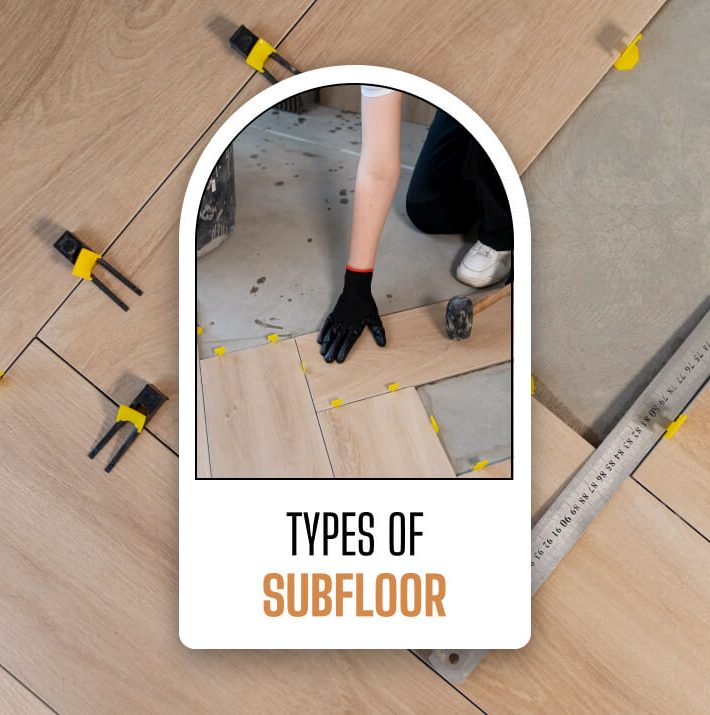
What are the types of subfloors? This is a question that I have been asked a number of times. And believe it or not, I always say that it is one of the most important things in the house.
If you want to know about subflooring and its types, you have come to the right place. Keep reading this article till the end to know more about subfloors…
Subfloor: What Is All That About?
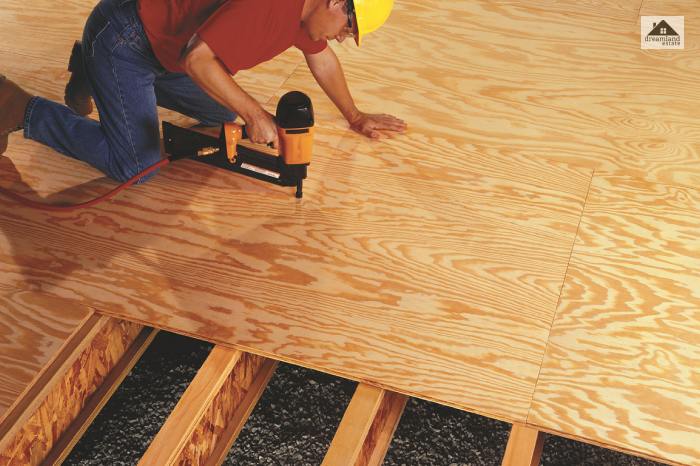
Technically speaking, a subfloor is one of the foundational structures of the floor. You may have seen a lot of different types of subfloors in old houses. But what are they, and why do you need them?
Subfloors, as I have already mentioned, are one of the building blocks of the floor. It adds durability to the floors and allows them to support the weight of furniture.
No one wants to experience the trauma of seeing their weak floor break, unable to carry the weight of the stuff that is placed on it, right?
That is exactly why most old houses, even the new ones, have subfloors.
Now that you know what subfloors are, let us get into the details of how many types of subfloors there are.
Types Of Subfloor: How Many Are There?
Now, here comes the question— how many types of subflooring are there?
Technically speaking, there are around five main types of subfloors based on the material they are made of. They are:
- Plywood Subfloor
- Concrete Slab
- Oriented Strand Board (OSB)
- High-Performance Panel
- Particle Board
Let us take a look at each of them individually. So keep reading this article till the end to learn more on the respective…
1. Plywood Subfloor
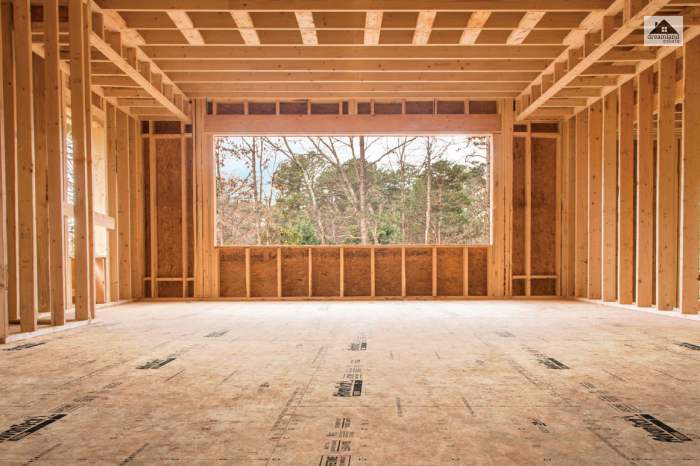
One of the most common materials for making a subfloor is plywood. You may be surprised to learn that, until the 1980s, plywood was the only material used to make subfloors.
As most of you may know, plywood is made by layering sheets of wood veneer and binding them together with high-duty adhesives.
Furthermore, this process of layering multiple wooden veneers gives them durability like none other.
There are different types of plywood for subflooring. However, all of them provide the same amount of strength and durability.
This means you can have a very strong base and use it as excellent, secure flooring.
2. Concrete Slab
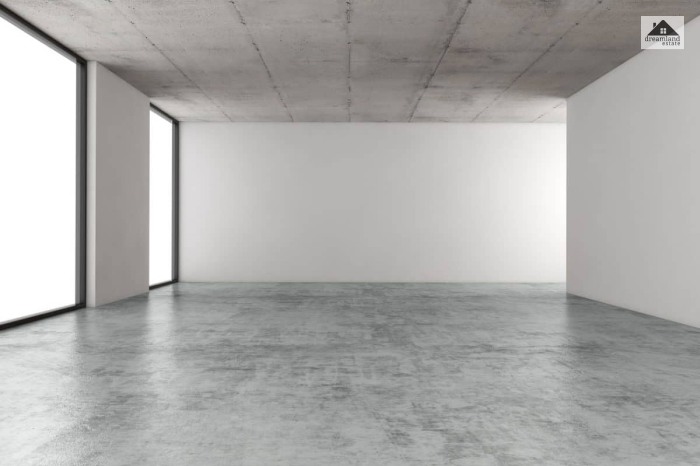
The next on the list of subflooring types is the Concrete slab. It is, as the name suggests, made of concrete and water.
Unlike plywood subfloors, concrete slab subfloors take a very long time to dry.
Most people choose this type of subfloor, thinking it will solve all moisture-related problems. However, they are wrong.
Moreover, this is the reason why it’s advised to check before installing the floors above the concrete slab.
Make sure that your concrete slabs are completely dry before installing the finished floors. If this step is skipped, you will have trouble later and probably end up with dampened floors.
However, there is absolutely no doubt that you will have a very strong, sturdy floor if you stick with concrete slabs.
While installing floors, make sure that they are made of traditional hardwood. Concrete slabs go well with this kind of wooden flooring.
3. Oriented Strand Board (OSB)
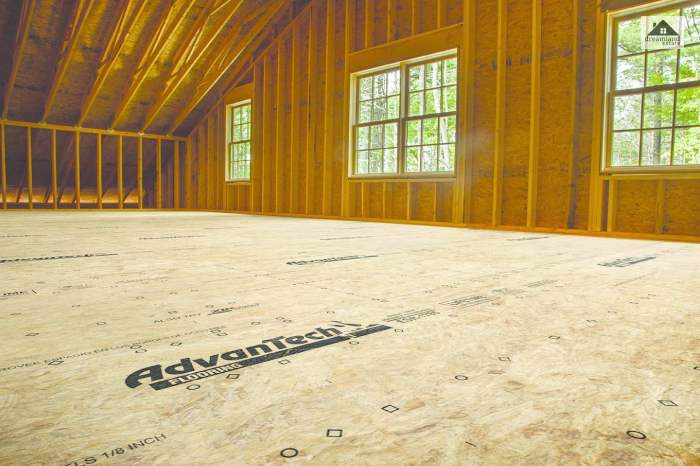
Another important and extremely popular material for subfloor is the OSB. OSB stands for Oriented Strand Board.
This subfloor material got its name because of the way they are made— layering strands of wood.
The way they are used and installed is very similar to that of installing plywood subfloors. However, they are not the same thing.
Plywoods are made by gluing together thin sheets of wood veneers.
On the other hand, OSB is made from wood strands that are rectangular in shape and arranged in a crisscrossed manner with the help of heavy-duty adhesives.
As a result, they are much more uniform compared to plywood. At the same time, they are less expensive too.
4. High-Performance Panel

Last but not least, we have the High-Performance Panels. They are used a lot in buildings these days as they offer similar benefits as OSB and plywoods.
Furthermore, One of the important reasons why they are used is because they are moisture-resistant.
These panels are stiffer and can hold much more weight than you think. And all this is thanks to the panels’ resin technology.
However, they are not the cheapest option that you will find.
5. Particle Board
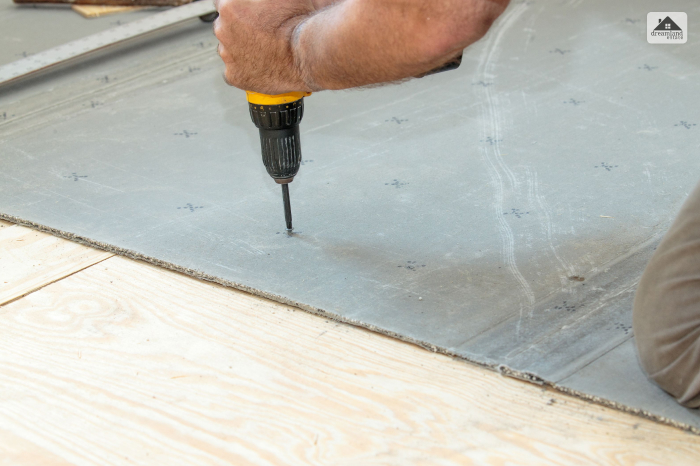
Particle boards are somewhat similar to plywood boards. However, Particle boards are made from wood chips, sawdust, and other wood particles.
All of these particles are bonded with resin and pressed into a board. Particle boards are affordable and offer intermediate resistance to termites, fire, etc.
Therefore, these boards are perfect for people living in apartments who do not want to spend too much on subflooring.
Particle boards are amazingly well-insulated and can keep moisture from seeping into the structure.
However, particle boards have lower durability than plywood or concrete slabs. As a result, particle boards are prone to cracking and warping.
Therefore, you need to add a special vapor barrier while installing. Also, you need to take special care when securing the board to prevent it from warping.
6. Strong and Reliable Plywood
Flooring is generally considered the most fundamental aspect of any building work.
Plywood is made by compressing several layers of wood veneer with glue, with the layers oriented at right angles to each other to provide strength.
This can further prevent warping and bending over time.
Since plywood tightly holds the nails and screws, your floors will remain silent and stable when you walk across.
In case your structure is a floor joist, you can select either 18 mm or 25 mm plywood sheets for maximum stability.
7. Budget-Friendly Chipboard
Looking for something cheap that won’t break the bank? Chipboard is very popular because of its low price.
It consists of glued wood chips, and you normally find it in new houses or loft conversions.
In fact, it is nice and easy to install, just don’t forget to choose the moisture-resistant “P5 grade”.
Normally, an 18 mm thickness is sufficient for narrow gaps. However, 22 mm is recommended when floor supports are far apart.
8. Classic Timber Floorboards
There are homes built long ago whose charming original pine floorboards are still in place.
However, because Pine is a soft wood, these boards eventually exhibit gapping, creaking, and warping with seasonal changes.
Moreover, you will not achieve a good result by simply laying new wood over the existing one.
Instead, screwing down any loose bits and putting down a layer of plywood over them is the ideal way to create a flat, smooth surface.
What Are The Common Methods Of Subflooring Installation?
Here are the common methods that can help you to install flooring!
| Flooring Category | Concrete Substrate | Timber Plywood | Standard Floorboards | Chipboard Base |
|---|---|---|---|---|
| Solid Hardwood | Adhesive + DPM | Glue or Cleats | Mechanical Fix (Nails) | Adhesive Bond |
| Engineered Planks | Float or Glue | Float or Glue | Floating (Underlay) | Float or Glue |
| Parquet Blocks | Direct Adhesive | Direct Adhesive | Surface Prep Req. | Direct Adhesive |
| Laminate | Underlayment | Underlayment | Underlayment | Underlayment |
| Bamboo | Underlayment | Underlayment | Surface Prep Req. | Underlayment |
| Cork Tile/Plank | Underlayment | Underlayment | Underlayment | Underlayment |
How Can You Maintain Your Subfloor?
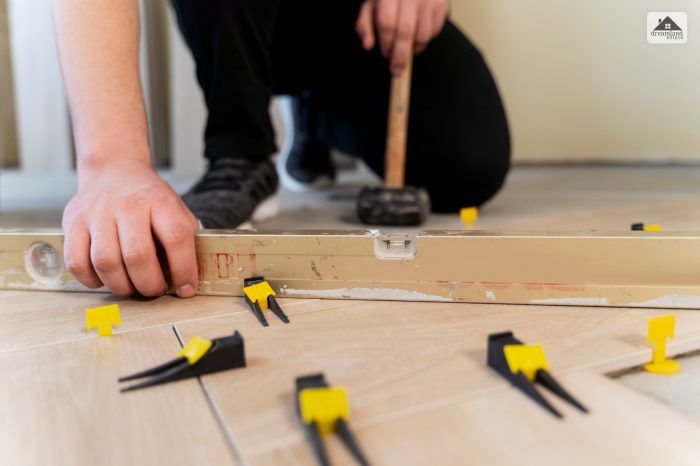
Installation of the subfloor is an important aspect of any renovation project. Subflooring decides several aspects, like the structural integrity of the flooring, along with some other aspects like insulation, etc.
As a result, subflooring projects usually require extensive research on aspects like measuring the moisture level. This is done in order to see if the moisture level is at par with manufacturing requirements. This measurement is also used to determine the difference between the required moisture level along with the difference.
The best way to safeguard your subflooring is by adding a moisture retardant spray or chemicals. These chemicals lock out moisture and keep the board dry. Moisture retardant is a must if you are residing in a humid area. Otherwise, the longevity of your board would be severely hampered over time.
While deciding upon subflooring material you should take the aid of an expert. My suggestion would be to get professional help and get some moisture tests done. This will aid you in making the right decision. An expert would help you understand the nuances of subflooring and the markers that you need to know in order to finish the subflooring project.
Finally, do not cut costs when it comes to subflooring. Even if you have to put some more money into subflooring, I would suggest you do so without hesitation.
What Are The Best Flooring Companies Of 2024
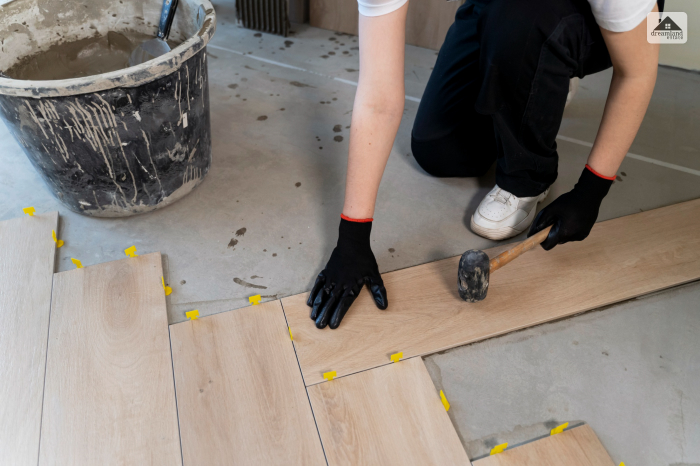
Flooring is an essential aspect of a renovation or a construction project. As a result, it is important to hire professionals in order to get this work done. Here are some of the best flooring companies that you need to know about in order to make the right choice.
Empire Today, LLC
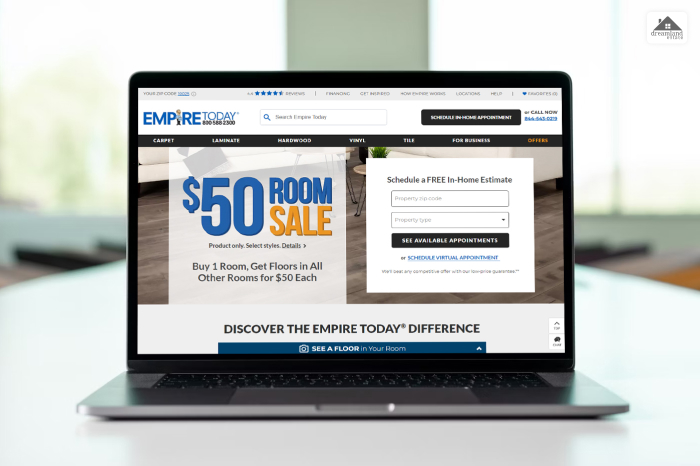
Empire Today has been in the business since the 60s. As a result, the company has extensive knowledge about flooring requirements. The company has grown from being a local company to a business giant that operates across 32 states.
Mr. Handyman

Mr. Handyman is a one-stop shop for all of your construction requirements. The brand has named itself brilliantly. Folks at Mr. Handyman are known for their expertise in a myriad of aspects and have worked across 38 states.
Luna Flooring
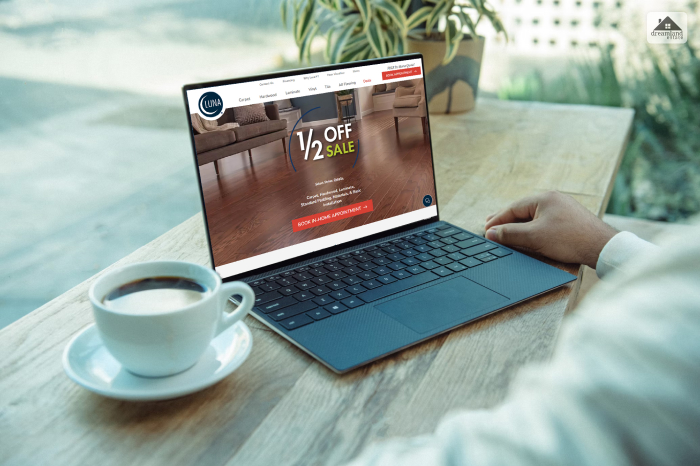
Finally, Luna Flooring is the third name on our list. The brand has become immensely popular among people who want to renovate their house at an affordable cost. The brand provides a two-year installation warranty. As a result, you can be sure about the brand’s sustainability and quality of work.
Frequently Asked Questions (FAQs)
Now that you have read most of the article, I hope that you have found the answer to your search. You might want to check out some of the questions that readers frequently ask…
In case you were searching for some of the cheapest as well as the best subflooring materials, you have reached your destination. At present, OSB or Oriented Strand Board is the cheapest out of all subfloors.
While there are many subfloors that you can find for your house, the best and strongest subfloor that you may find is plywood. You may also use the OSB, or the Oriented Strand Board, as this is yet another strong material you can use to make your subfloor.
The subfloor of a house is a structure that is attached to the floor. The main function of the subfloor is to ensure that it provides enough support to the main floor of the house. In this way, it helps the floor of the house to be strong enough to carry the weight of the household.
Read More:


Leave A Reply