






What Does Contingent Mean In Real Estate? Hidden Facts You Need To Know!

So the phrase “what does contingent mean in real estate” gets searched a lot because the label looks simple, but the transaction behind it is not at all. A house can appear nearly sold, still wobble, and then land back on the market if one condition fails.
That is the part many quick explainers smooth over. Contingent is not a finish line. It is a contract stage with pressure still inside it.
In practical terms, a contingent home is one where the seller has accepted an offer. However, the sale still depends on satisfying particular conditions before closing.
In general, those conditions might involve financing, appraisal, inspection findings, title review, or the sale of another property. Although the accepted offer matters, the unresolved conditions matter a lot.
Reading the Status Correctly
The bigger issue is that what does contingent mean in real estate cannot be explained well unless listing status and contract strength are separated.
For instance, an active property is available for showings and offers. Also, a contingent property has an accepted offer, but one or more conditions in the contract are still open. Moreover, a pending property is further along.
The major contingencies have usually been removed or waived, and the deal is moving toward closing. Essentially, “sold” or “closed” is the actual finish. In fact, different portals compress these stages, which is why buyers often misread a listing at first glance.
| Status | What It Usually Means | Showings Possible? | Backup Offers Possible? | Deal Certainty |
|---|---|---|---|---|
| Active | No accepted offer yet. The property is openly marketed. | Yes | Not relevant | Moderate |
| Contingent | Offer accepted, but key conditions are still unresolved. | Sometimes | Often yes | Uncertain |
| Pending | Offer accepted, and major contingencies are usually cleared. | Sometimes no | Rarely | Stronger |
| Sold or Closed | Ownership transfer is completed. | No | No | Final |
What Are The Common Contingency Types?
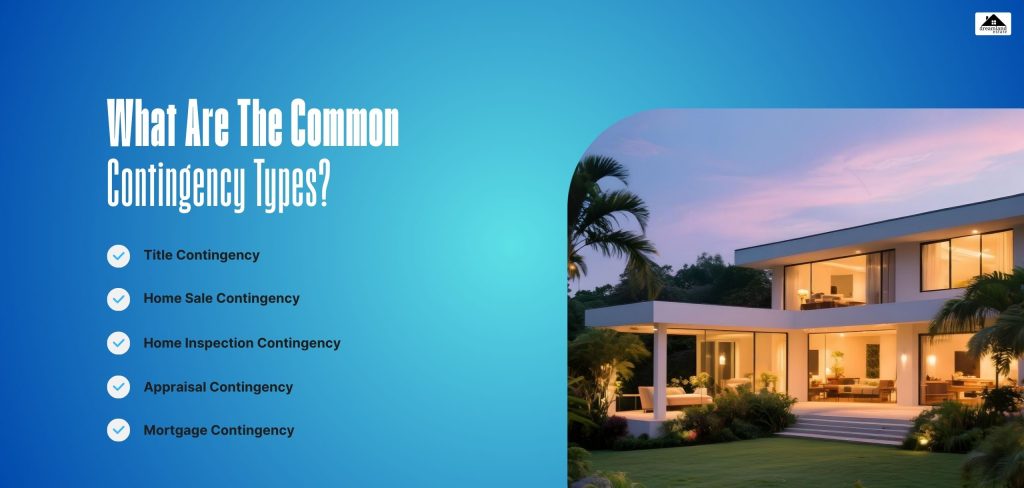
You can set specific rules for the deal when you buy a house. These are known as contingencies.
They act as your safety nets during this process. Here are the five most common types of contingencies that you must know about before making your next big offer!
1. Title Contingency
You must ensure the seller truly owns the home and has no unpaid tax debts. This protection guarantees a clean legal transfer of ownership.
You might inherit someone else’s expensive legal problems or liens after you move in, without it.
2. Home Sale Contingency
Use this if you need to sell your current house to afford the next one. It gives you a specific timeframe to find a buyer.
Moreover, you can back out of the new purchase completely safely if your home does not sell.
3. Home Inspection Contingency
I always suggest hiring a professional to check for hidden issues such as mould or faulty wiring.
You can ask for a lower price, request repairs, or simply walk away with your deposit money back if the inspector finds major damage.
4. Appraisal Contingency
Lenders will not give you a loan for more than a house is actually worth.
If the bank’s valuation comes in below your offer price, you can renegotiate the deal or cancel it without losing any money.
5. Mortgage Contingency
Your final loan could still get denied by the bank, even with a pre-approval. This protects you if your financing falls through at the last minute.
Moreover, it ensures you aren’t legally forced to buy a home you cannot actually afford.
The Contingency Period Is Where the Deal Gets Tested
At the outset, contingencies are not just labels on paper. Rather, they come with deadlines, response windows, extension requests, and removal procedures.
- Inspection periods can close quickly.
- Financing approvals can shift late in the process.
- Title objections may need correction before closing.
- A low appraisal can force either renegotiation or a cash-gap decision.
None of that is cosmetic. Basically, it is the transaction’s stress test.
Hence, a cleaner way to read contingencies is to see each one as a distinct risk filter. In fact, inspection contingencies test physical condition and repair exposure.
Appraisal contingencies test whether the agreed price can survive lender scrutiny. Financing contingencies test whether the buyer can actually fund the purchase, not just talk confidently about pre-approval.
If a contingency deadline passes without the right notice or extension, earnest money protection may not remain as strong as buyers assume.
| Inspection contingency: It checks the condition risk and repair leverage.Appraisal contingency: It checks valuation risk and possible cash shortfall.Financing contingency: It checks whether the loan can really close on time. |
Examples Of Contingency In Real Estate
The process of buying a home is like a step-by-step game. Here’s how it works using contingencies:
First, you find a house you love. You make an offer, but you add “safety nets” called contingencies.
This basically says, “I’ll buy it, but only if the inspection looks good and the bank says it’s worth the price.”
While you’re checking things out, the house status changes:
- Contingent: This tells other buyers you have a deal in place, but you’re still making sure everything is okay.
- Pending: Once your inspection and appraisal pass, you “release” those safety nets. The deal is now firm but not finished.
- Sold: You sign the final papers, get the keys, and the house is officially yours!
The Types Of Contingent Listings
Now that you have the idea of what does contingent mean in real estate, it is time to understand the listing types.
When you are browsing listings, you will see different types of contingency statuses. These tell you exactly what is happening with a deal and if you still have a chance to jump in.
Here are the most common ones you will run into:
Continue to Show (CCS): The seller has an offer but does not yet fully trust it. They will still let you tour the house and take backup offers just in case.
No-Show: The deal looks solid. The seller is confident enough that they have stopped showing the home to anyone else.
Kick-Out: This is a gamble for the buyer. The seller can continue marketing the house and “kick out” the first buyer if a better offer comes in.
Probate: This usually involves an inheritance. The sale is on hold, awaiting a court’s thumbs-up. Thus, you must expect a long wait.
Short Sale: The home is being sold for less than what is owed on the mortgage. The bank has to approve everything, which can take months.
Once you understand this, you can tell which homes are worth your time and which might be a headache.
A Quick Reality Check on Listing Labels
Before breaking down specific listing labels, one point needs to be made plainly. These status terms are not perfectly standardized across all MLSs, brokerage platforms, or markets.
One system may say contingent. Another may say active under contract. Meanwhile, another may split the same stage into continue-to-show or no-show variations.
So the label matters, yes, but the local listing rules matter too. Without that qualifier, readers can leave with more confidence than accuracy, which is not helpful for a contract-sensitive topic like this.
Can I Still Make An Offer On A Contingent Home?
Do not give up just because you see a “contingent” tag! It does not mean the house is gone for good.
In fact, deals fall through all the time. If a buyer can’t get their loan or the inspection reveals a massive leak, that house is back on the market.
This is where you can be smart! Just stay ready. You just need to keep an eye on the listing in case it pops back up.
Secondly, you can check out the backup offers. Many sellers will actually accept a “safety” offer from you.
If the first deal fails, you are already first in line to grab the keys. It’s a great way to skip the line and win your dream home when others think it’s already sold.
What Buyers and Sellers Usually Miss
Most explainers stop at the dictionary meaning of what does contingent mean in real estate and then call it a day. That is not enough.
In fact, sellers are not just waiting around for paperwork. Rather, they are judging the following:
- Realism of the buyer’s financing
- Likelihood of aggressive repair demands
- Chance of an appraisal shortfall
- Whether a backup offer should stay in orbit.
The status is not passive. It is a risk-management stage.
For buyers, the smarter question is not whether a contingent home is technically available. The smarter question is whether the current contract looks stable or brittle.
Essentially, a home-sale contingency often introduces more uncertainty than a routine inspection contingency. However, weak financing can stall a deal late.
Appraisal trouble can reopen price negotiations at exactly the wrong moment. Reading the contract’s structure matters more than reacting to the portal label alone.
| Contingency Issue | What Can Go Wrong | Who Feels Pressure First | Typical Result |
| Inspection | Major defects, repair disputes, and hidden system damage | Buyer first, then seller | Repair request, credit, renegotiation, or exit |
| Appraisal | Value comes in below the contract price | Buyer and lender first | Price cut, cash gap, or cancellation |
| Financing | Loan denial, delayed underwriting, document issues | Buyer first | Extension request or deal failure |
| Home Sale | The buyer’s current home does not sell in time | Seller first | Delay, kick-out pressure, or collapse |
Why Does It Matter To Understand The Meaning Behind “Contingent”?
The idea of what does contingent mean in real estate gives you a huge edge.
Instead of just scrolling past, you can spot hidden gems that might come back on the market.
It is all about staying alert and knowing when a “sold” sign isn’t actually permanent yet.
To play it smart, keep those listings on your radar in case the first deal hits a snag. So, lean on an expert loan officer and agent for help.
They will tell you if a house is worth the wait or if you should move on to other homes that are fully available.
Whether you are making a backup move or starting fresh, once you have the right pros in your corner, the whole process is way less stressful.
Contingent vs. Pending

At the outset, the distinction is simple, but complex underneath.
A contingent property is under contract. However, one or more conditions must still be met for the sale to proceed smoothly.
A pending property is usually further along. In this case, the big contingencies have been resolved, waived, or removed. Also, the transaction is now closer to closing than to renegotiation.
That does not mean pending equals sold. Actually, it does not. In fact, closing still has to happen. Also, funds still have to be transferred. Moreover, final documents still have to be executed.
But pending does signal a narrower path left to walk. Contingent still carries more moving parts. That is the difference readers actually need.
How Does Contingent Status Affect Both Buyers And Sellers?
The path to purchasing a house is usually not a simple one that goes from “yes” directly to “sold”. Being in contingent status is being in a place in between, where things can get complicated.
Still, it also opens up some very good loopholes. But this is from the perspective of which side of the transaction you are on.
From your perspective as a buyer, the contingent tag is just like a flashing green light. It suggests that the door has not been completely closed yet.
In case the present transaction encounters a problem, e.g., a poor inspection, you will be able to make your move.
It is better to submit a backup offer most strongly. By doing this, you are placed next in the queue, and so you won’t have to compete with other buyers when the first one fails.
For sellers, this moment is more about dealing with “if”. Having a buyer is wonderful. Nonetheless, insecurity is very real.
You should also scrutinize their terms for a long time to determine whether they are feasible.
Thus, changing contingencies is the only moment you can finally breathe without hesitation.
Stay Aware of Contingency
In the end, what does contingent mean in real estate is not just a vocabulary question. Rather, it is a contract-risk question. For instance, the seller has accepted an offer. Still, the sale depends on conditions being met on time and in sequence. Also, the deal must not unravel under inspection, appraisal, financing, or title pressure. That is the clearer, more useful definition readers actually need.


Leave A Reply