






Understanding Corpus Fund Management And Its Role In Financial Sustainability
A financially healthy housing society needs very careful planning. It is about more than daily chores. It is also about long-term peace of mind.
That is where a corpus fund comes in. You can think of it as a community piggy bank or a reliable backup plan.
Essentially, a corpus fund is a special reserve that apartment buyers collectively contribute to.
Consequently, this money can help the management to handle things such as:
- Major repairs,
- Future upgrades,
- Sudden building emergencies
Best of all, having this strong financial cushion means members do not get hit with sudden, heavy monetary demands later on.
Ultimately, it keeps the property values up and the community completely stress-free. Let us look at exactly how it works and how societies calculate it.
Quick Summary: What You Need to Know
If you are short on time, here is a fast look at what a corpus fund is and why it matters to you:
- The Core Definition: A permanent, non-refundable cash reserve collected from homeowners to guarantee the long-term survival and stability of a housing society.
- The Main Purpose: It skips everyday chores and focuses strictly on big-ticket expenses like major structural repairs, smart security upgrades, and building redevelopment.
- The Big Benefits: It naturally boosts your property value, keeps the community financially independent, and shields you from sudden, stressful emergency bills.
The Key Rule: The money belongs to the building, not the individual. When you sell your apartment, your share stays in the fund to protect the next owner.
What Is A Corpus Fund?

Cheers, but what exactly is a corpus fund? Basically, it’s the savings account at the heart of your housing society.
You will also come across the term “capital fund”. This is basically a collection of money that the society uses as its contingency fund to keep the building safe, stable, and smoothly functioning for years to come.
This fund is different from your routine monthly maintenance charges, which are for everyday chores like paying the security guard or cleaning the lobby.
So, what it’s really meant for is to be gradually accumulated through initial contributions from the homeowners.
And in short, the corpus fund is basically a permanent safety net. Since the money is kept safe in the society, it will be able to handle big long-term stuff.
Corpus Fund In Society
A corpus fund basically serves the same purpose as a joint savings account in the case of a housing society.
You can imagine it as a huge backup fund that is reserved to maintain shared spaces and common amenities.
In the beginning, the builder or contractor gathers this money from each buyer, especially when a person buys their home.
This money is used to pay for major maintenance, large utility bills, and deep cleaning during the initial years.
But the builder is legally required to pass this money over to the residents only when an official managing committee is formed by the residents themselves.
After that, the residents are given total control over the corpus fund, which ensures your building stays beautiful and safe, without neglect, for everyone.
What Are The Advantages Of Corpus Fund?
A large corpus fund in a housing association brings serious, tangible benefits to the community that are easily quantifiable.
The fund will move the community away from a tense, reactive lifestyle and toward intelligent, long-term wealth management.
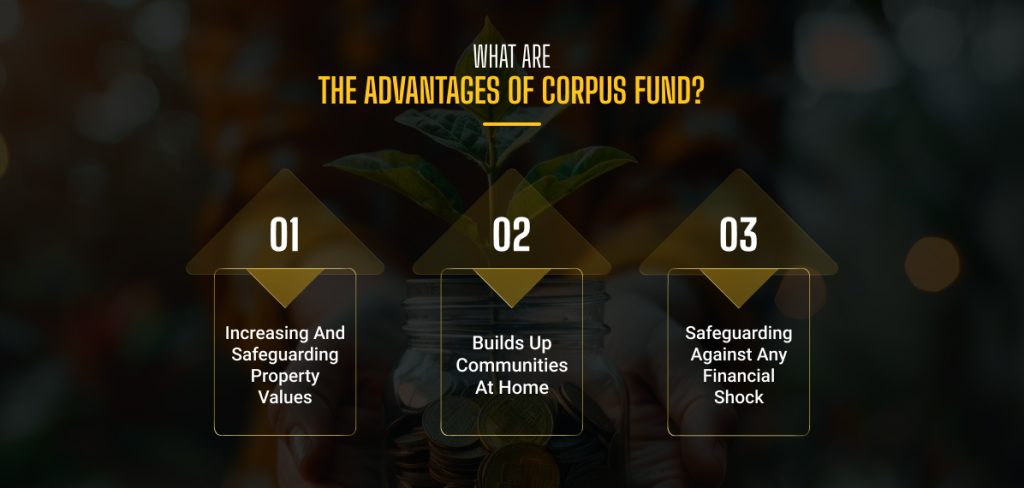
· Increasing And Safeguarding Property Values
A well-balanced reserve fund has an immediate, data-driven boost on the property’s monetary worth.
Trends in the housing market indicate communities with good maintenance and facilities get a valuation 10% to 15% higher on average than poorly maintained structures nearby.
First Impressions Matter: The money keeps lifts working smoothly, structural paint looking brand new, and landscaping neat.
Higher Yields: Lastly, this regular maintenance will attract quality tenants and buyers naturally, thus protecting your investment from market volatility.
· Builds Up Communities At Home
Besides just the physical elements of the building, a residential community is essentially a network of people that depend on each other.
The surplus of the corpus fund can be put to good use in building activities. The residents need to know that it won’t be used for daily expenses.
Fostering Communities: In that case, the managing committee can use the corpus fund in an almost unnoticed way to sponsor cultural events, safety exercises, and wellness activities.
Redrawing Differences: When a home community has a stable financial situation, its residents tend to get along based on joint festivities rather than fighting over maintenance increases when they are least expected.
· Safeguarding Against Any Financial Shock
A cash reserve is an essential component in a financially healthy home.
A housing association is considered the best example of having a corpus fund that allows it not to rely on borrowing, as per the principles of finance.
A perfect example is a housing association that can cover 6 to 12 months of total repairs in case of the sudden breakdown of a critical structural component like a basement generator or a water pump.
Cost-Free Maintenance: The managing committee can handle the breakdown through the reserve.
No More Debt or Special Assessment Bills: Residents are absolutely safe from receiving sudden “special assessment” bills or falling into debt by borrowing from banks.
This is because the reserve money can take care of everything, and their monthly budget will remain predictable and safe.
Why Is It Necessary To Create A Corpus Fund For A Housing Society?
When trying to create a strong corpus fund, you must rely on a team environment and keep a consistent timeline.
This money will cover everyone’s shared investments, so every individual homeowner contributes a small but vital sum over time from the residential area to grow such funds.
What Are The Flexible Ways To Collect The Money?
Societies normally get these contributions in a handful of different ways, whatever suits their people best:
- The Installment Plan
Many communities decide to divide the amount. They charge a small sum, along with maintenance fees, on a regular monthly, quarterly, or annual basis.
- The One-Time Lump Sum
On the contrary, the society might require a certain percentage of the property sale price of the whole. The buyer pays this amount at the time of purchase.
Danger Of “Maintenance-Free” Schemes
If you, for example, buy a house in a new development and the promotion is to have a “maintenance-free” period for the first year or two, this would, of course, attract a lot of buyers.
The fine-print details have to be checked, though, before the buyer signs the contract.
The thing is that these types of schemes often just defer your payment towards the corpus fund and not totally eliminate the responsibility.
Thus, an experienced buyer always reads the contract between buyer and seller to find out at just what point in time their financial duty starts.
This will prevent any unexpected issues arising later on.
How Can You Use Corpus Fund In Society?
A corpus fund or a reserve fund in a housing society is a great tool that can be used flexibly by the managing committee.
Since it acts as a long-term capital buffer, it can be used for significant purposes to support the community.
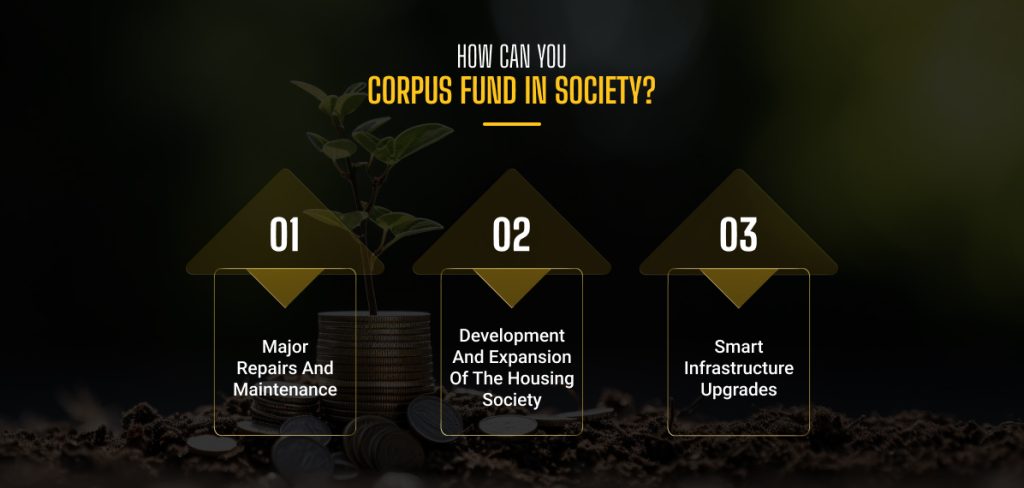
· Major Repairs And Maintenance
Mainly, through the fund, they arrange for major, not-so-timed repairs and structural works that cannot be financed from the regular maintenance fees.
The housing society uses this money to repair the costly shared infrastructure rather than letting it slowly deteriorate.
Hence, this preventive repair work ensures the building remains safe and working well for a long time.
· Development And Expansion Of The Housing Society
As years go by, old buildings definitely require major structural changes or may need to be rebuilt totally.
A substantial corpus fund is a way out for the society as it provides the right capital upfront to initiate the redevelopment of the housing society.
With the help of corpus fund money, the community may construct new facilities independently.
This includes a more updated club or a renovated community temple, rather than being financed heavily through high-interest bank loans.
· Smart Infrastructure Upgrades
As technology advances, outdated buildings quickly need to be upgraded. This is the reason societies use these capitals.
Budgeting for the installation of solar panels, which is one of the best ways of utilizing natural resources as a source of energy, the use of high-quality biometric gates for entry, and the installation of advanced CCTV systems.
This helps the society bring down its utility bills while significantly enhancing the comfort level of the inhabitants in terms of security.
Corpus Fund Uses Overview
| Purpose | How the Corpus Fund is Used | Real-World Examples |
|---|---|---|
| Maintenance and Repairs | Handles heavy structural upkeep and large fixes for shared spaces. | Replacing an old lift, external wall repainting, and fixing terrace waterproofing. |
| Redevelopment of Housing Society | Funds major structural rebuilds or new community additions without loans. | Constructing a new gym, expanding the clubhouse, or rebuilding aged towers. |
| Upgradation of Infrastructure | Modernizes the property with smart, eco-friendly systems. | Installing common-area solar panels, EV charging stations, and smart CCTV networks. |
| Emergency Expenses | Offers instant cash for dangerous, unexpected structural damage. | Fixing a collapsed compound wall, major electrical fires, or bursting water mains. |
How Is A Corpus Fund Calculated?
Estimating your corpus fund can be a challenging task, especially during the redevelopment work.
The redevelopment phase of the house mainly revolves around computing the total financial assistance required by the flat owner.
This way, they can live comfortably while their house is being rebuilt.
Simply put, the aim is to ensure residents do not bear any expenses while living temporarily elsewhere during redevelopment.
Determining Factors Of The Calculation
Floor management teams and developers usually split the computation into four key areas to arrive at the final number.
· Compensation for Monthly Rent
The developer gives you, as a new homeowner, the market-level rent of your neighboring flat, assuming that you will need a place to stay while your home is under construction.
Compensation of Whole Rent = Market Rent Price × (Time of Redevelopment in Months)
· Shifting Costs
Everyone knows that moving is a hassle. Hence, it is just a one-time benefit that will help you cover the expenses of packing, moving out, and finally packing all belongings to return to your new home.
Shifting Costs usually amount to between fifty thousand rupees and one hundred thousand rupees per flat.
· Hardship Amount
Changing from a familiar setting is a big hassle, so many developers decide to provide you with an additional cushion of 50k to 2 lac by way of hardship allowance to compensate you for this inconvenience.
· Extra Area Fund
An additional reserve will often be computed based on the new space if the developer gives you free extra space in the new building.
Extra Area Fund = (Additional square feet) × (Rate per Square Ft)
The Total Corpus Fund Formula
Picking up all the bits and pieces, you should end up with an individual apartment total corpus fund formula that is pretty simple:
Total Corpus Fund = (Market Rent x Number of Months) + Shifting Charges + Hardship Allowance + Extra Area Compensation
Total Corpus Fund Formula Overview
| Component | Details & Typical Amounts | What It Covers |
|---|---|---|
| Monthly Rent Compensation | Equal to the current market rent in your exact locality. | Your temporary housing costs during construction. |
| Shifting Charges | A one-time payment of ₹50,000 to ₹1,00,000. | Hiring packers and movers for both legs of the journey. |
| Hardship Allowance | A friendly bonus of ₹50,000 to ₹2,00,000. | Compensation for the general stress and disruption of moving. |
| Extra Area Corpus | New square footage times local rate per sq. ft. | Future maintenance backing for a larger home layout. |
Is a Corpus Fund Refundable?
The short answer is no. A corpus fund is generally completely non-refundable.
Even if you decide to sell your apartment, pack your bags, and further move away! This way, you cannot cash out your share of this money.
Why You Can’t Take It With You?
When you first take possession of your home, the builder collects this one-time amount.
This usually ranges anywhere from ₹10,000 to over ₹1,00,000 per flat.
This money is treated as a permanent investment in the building itself, rather than a personal deposit.
This is more like a gift to the property’s long-term health. Moreover, when you sell your home, the benefit of that financial safety net automatically transfers to the next buyer.
Moreover, this keeps the property valuable, stable, and highly attractive on the market.



Leave A Reply